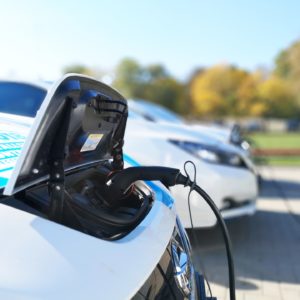
"The realities of physics and engineering mean that politicians pushing for an all-EV future run a high risk. Quite aside from the eventual discovery that EVs will disappoint with only a tiny impact on global CO2 emissions, the bigger impacts will come as consumers find vehicle ownership costs and inconveniences both escalating."
Articles from Around the Web
Why Verizon is betting on these four climate tech startups
"Based in San Juan, Puerto Rico, the company’s team of engineers, scientists, UX designers, and insurance experts are developing the next generation of parametric insurance in Florida, California, New York and Washington State. Raincoat partners with insurers, reinsurers, and governments worldwide in developing and distributing these solutions."
The surprising benefits of switching to ‘lamb mowers’
"It also brings other benefits. No chemicals are needed. The sheep selectively eat weeds and invasives (Lamb Mowers won’t serveany lawns treated in the last six months). Carbon from the grass is returned to the soil as sheep pellets. One 2006 study found replacing sheep for lawn mowers cut net emissions by more than a third (980 kgCO2e/ha/year). If you embrace the natural lawn and 'no mow' movement, the sheep help you make the transition from sod to meadow, and keep it healthy over time."
U.S. Deploys $3.5B Boost for Grid Resilience: Major Projects Revealed
"The biggest Grid Innovation recipient is the Minnesota Department of Commerce, which will receive $464 million to coordinate the planning, design, and construction of five transmission projects across seven Midwestern states, known as the Joint Targeted Interconnection Queue (JTIQ) Portfolio. The $1.8 billion JTIQ, launched by the Southwest Power Pool (SPP) and Midcontinent Independent System Operator (MISO) in 2020, aims at building transmission network upgrades along the MISO-SPP seams to enable new generator interconnections."
Why burying power lines is an effective, but very expensive way to prevent wildfires
"Since PG&E earns a guaranteed rate of return on capital investments, the utility is inherently incentivized to undertake more expensive infrastructure projects such as undergrounding, explained Morsony and Daniel Kirschen, a professor of power and energy systems at the University of Washington. This is how the utility makes money, not by selling electricity or gas."
To Track a Forest’s Recovery, Artificial Intelligence Just Listens
"Traditional methods of tracking biodiversity include metabarcoding, a type of analysis that looks at short snippets of DNA to identify specific populations of species. The researchers found that bioacoustic monitoring led to similar findings as this more direct method but can be accomplished at a lower cost and with less intrusion on the environment."
Regional Clean Hydrogen Hubs: A Milestone Towards a Cleaner Future
"The hydrogen hubs are a testament to what can be achieved when policy meets innovation. But this is just the starting line. We must remain unwavering in our commitment to policy evolution, infrastructure development, community involvement, and relentless innovation if we hope to unlock the full decarbonization potential of clean hydrogen."
This startup CEO claims he can completely decarbonize the cement industry
"'Ultimately, our plan, our goal would be to develop a credibly lower-cost process to make Portland cement at scale. And, therefore, because it’s lower cost, eventually, our process will replace 100% of cement production facilities worldwide, leading to a fully decarbonized system,' Finke said."
For lower income nations, fossil fuel debate rings hollow
"In some cases, new fossil fuel infrastructure could still lower greenhouse gas emissions compared to previous practices. Replacing wood and other biomass fuels with liquid propane for rural home cooking would reduce emissions and improve air quality. Deploying natural gas for local industry would be better than burning (also known as flaring) or releasing (also known as venting) the gas into the atmosphere in many cases."
Universal access to clean cooking lags behind
"Air pollution from rudimentary cooking fuels such as charcoal, firewood, coal, agricultural waste and animal dung causes 3.7 million premature deaths per year, ranking it the third largest cause of premature death globally, according to the report."