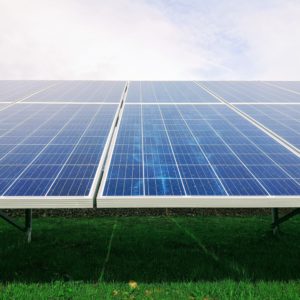
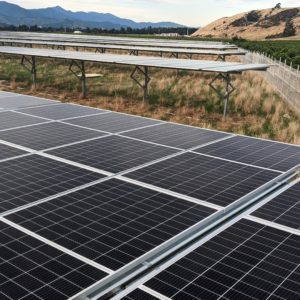
"Today, the U.S. has about five gigawatts of agrivoltaic projects, encompassing more than 35,000 acres across over 30 different states. While this only represents about 3% of the country’s installed solar capacity, it’s a growing industry, and farmers are taking note."
Amazon Expands Renewable Portfolio With Solar Farm at Reclaimed Coal Mine
"The second project in Maryland will be built in Kent County. The Amazon Solar Farm Maryland—Morgnec, which could have as much as 45 MW of generation capacity, is one of Amazon’s first agrovoltaic solar projects. The installation will use bifacial solar panels to harvest the sun’s energy, while at the same time allowing for the land beneath the panels to be used for growing crops."
Exxon Makes Lithium Play in Long-Term Bet on EV Demand
"The lithium industry, if it continues to grow in southwest Arkansas, is expected to bring thousands of jobs to a corner of the state that was in decline for decades after the 1980s oil crash. Thousands moved away as the region’s oil wells dried up and big plants closed."
Economic and Environmental Lessons from the United States
Later this month, world leaders will gather at the annual United Nations Climate Change Conference or COP28. As with most economic policy questions, this topic is being driven forward by the United States.
Economic and Environmental Lessons from Switzerland
The way to unlock the power of society and the private sector is by giving people the freedom to innovate.
The $2 Million Coal Mine That Might Hold a $37 Billion Treasure
"The U.S. consumed an annual average of 8,300 metric tons of rare-earth oxides in recent years, according to estimates from the U.S. Geological Survey. Ramaco and its third-party consultant estimate there are as much as around 1.1 million metric tons of rare-earth oxides in just over a quarter of the nearly 16,000 acres of land that comprise the site."
Green energy investment headwinds threaten Joe Biden’s climate targets
"The typical project built in 2022 took five years from the interconnection request to commercial operations, compared with three years in 2015. The backlog is worsening as more projects are attracted due to the incentives in the IRA, according to the report."
An Innovative Financing Model Is Ensuring Everyone Can Afford a Heat Pump
"Heat pumps don’t just make heating and cooling easier, they also cut the very carbon pollution that is making extreme heat more intense. The switch from propane heaters to heat pumps can cut a household’s annual carbon emissions by 6.3 tons, according to one analysis from Rewiring America, a nonprofit dedicated to electrifying homes across the U.S."
Carbon Removal Isn’t Just for Corporations. Individuals Are Paying For It, Too
"Other carbon removal companies, from Undo Carbon in London to Noya in San Francisco, have also started selling services to individuals. Climeworks, for its part, has attracted nearly 20,000 individual buyers to participate in its carbon removal program since 2019. As it takes time for companies to build out infrastructure to remove carbon and undergo a third-party validation of their work, it’s not uncommon for buyers to wait for years until their purchases can be delivered."
Why burying power lines is an effective, but very expensive way to prevent wildfires
"Since PG&E earns a guaranteed rate of return on capital investments, the utility is inherently incentivized to undertake more expensive infrastructure projects such as undergrounding, explained Morsony and Daniel Kirschen, a professor of power and energy systems at the University of Washington. This is how the utility makes money, not by selling electricity or gas."