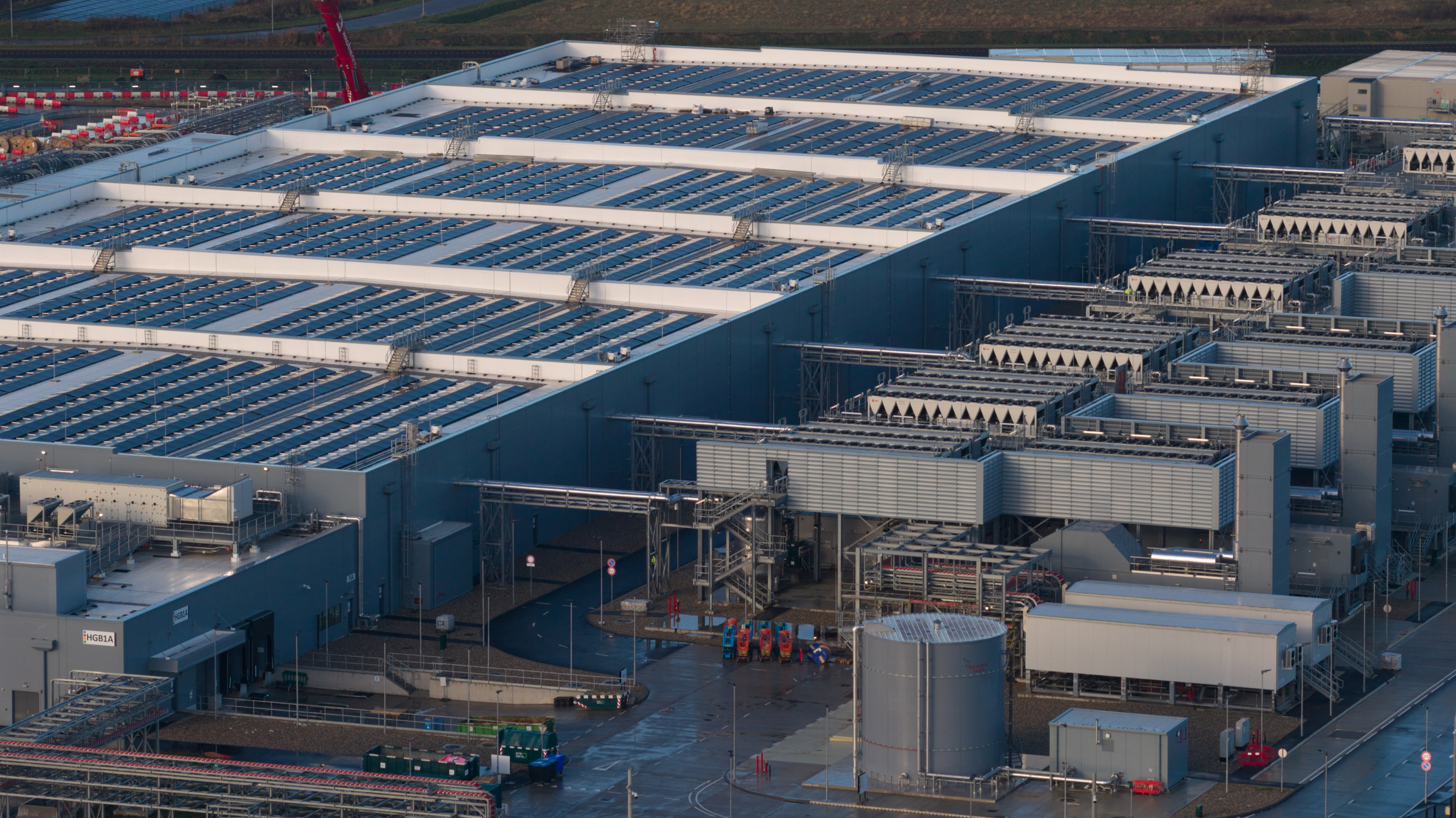
Some critics have complained that Trump’s Environmental Protection Agency can’t protect us from the supposed environmental harms of data centers if they cut down on red tape to streamline building permits. That’s part of a broader narrative that data centers are bad for the environment, but it ignores their benefits.
There are real concerns—water use, local ecological impact, and emissions chief among them—that deserve to be weighed seriously. But these concerns are often greatly exaggerated. Data center water consumption, for example, is a small fraction of what agriculture and municipal systems already use, a fact that underscores the need to keep concerns in proportion.
And these concerns are only one side of the ledger. Data centers can also offset environmental costs: they raise tax revenue that can fund conservation, power technologies that help us do more with less, drive the economic growth that makes environmental protection possible, and concentrate computing far more efficiently than the alternative.
First, data centers can literally pay for conservation.
Look at Loudoun County, Virginia, the data center capital of the world. Roughly 40 percent of the county’s tax revenue now comes from data centers. That money helps fund public services, including parks. I recently visited Ball’s Bluff Battlefield Regional Park in Loudoun with my family, and it’s over 250 acres of trees, fields, hiking trails, and river views providing habitat for over 150 wildlife species (not to mention preserving a Civil War historic site). And that’s just one park. Loudoun County’s Department of Parks, Recreation and Community Services maintains over 4,000 acres, including nature centers and reserves. The data center industry accused of changing the landscape is directly paying for the preservation of the parks and natural spaces that conservationists want to protect.
Second, data centers power AI, and AI can help the economy “do more with less.”
Data centers do draw real power and water, but the technology they enable can offset part of that use. AI can make supply chains, agriculture, transportation, and countless other activities more efficient, producing more economic value while using fewer physical resources. Improving the efficiency of farming irrigation systems alone could save a huge amount of water, undercutting fears of a data center-induced drought, especially since agricultural irrigation uses many times more water than data centers. AI is also being used directly for projects that benefit the environment, like monitoring wildlife and improving energy systems.
Third, a wealthier economy is a cleaner one.
Economic growth is good for the environment, and data centers are good for economic growth. The Yale Environmental Performance Index shows a strong relationship between wealth and environmental performance. Richer countries generally have better environmental outcomes because wealthier societies have more resources to invest in conservation, more efficient infrastructure, superior waste disposal, better technology, and more land set aside for conservation.
Finally, data centers built in the U.S. are better for the environment than the alternatives.
>>>READ: How Data Centers Can Help the Grid
As large, visible facilities, data centers are an easy target for critics. But concentrating computing in highly efficient facilities, rather than thousands of small, inefficient on-premises server rooms, generates more computation per unit of energy than a distributed system would.
And the alternative to domestic data center construction could be their construction in places with greater environmental harms—especially China, the world’s biggest polluter, whose carbon emissions exceed those of not only the United States but of all developed nations combined. If AI infrastructure is going to be built somewhere, building it on a grid that is cleaner per unit of energy than China’s coal-heavy one is the environmentally preferable outcome.
Data centers can provide the infrastructure for a wealthier, more technologically advanced and resource-efficient American economy, helping preserve our natural environment even as we take their real costs seriously. Built here, on a cleaner grid and in place of more wasteful alternatives, they are less environmentally damaging than the realistic alternatives to them, not more.
The views and opinions expressed are those of the author’s and do not necessarily reflect the official policy or position of C3.