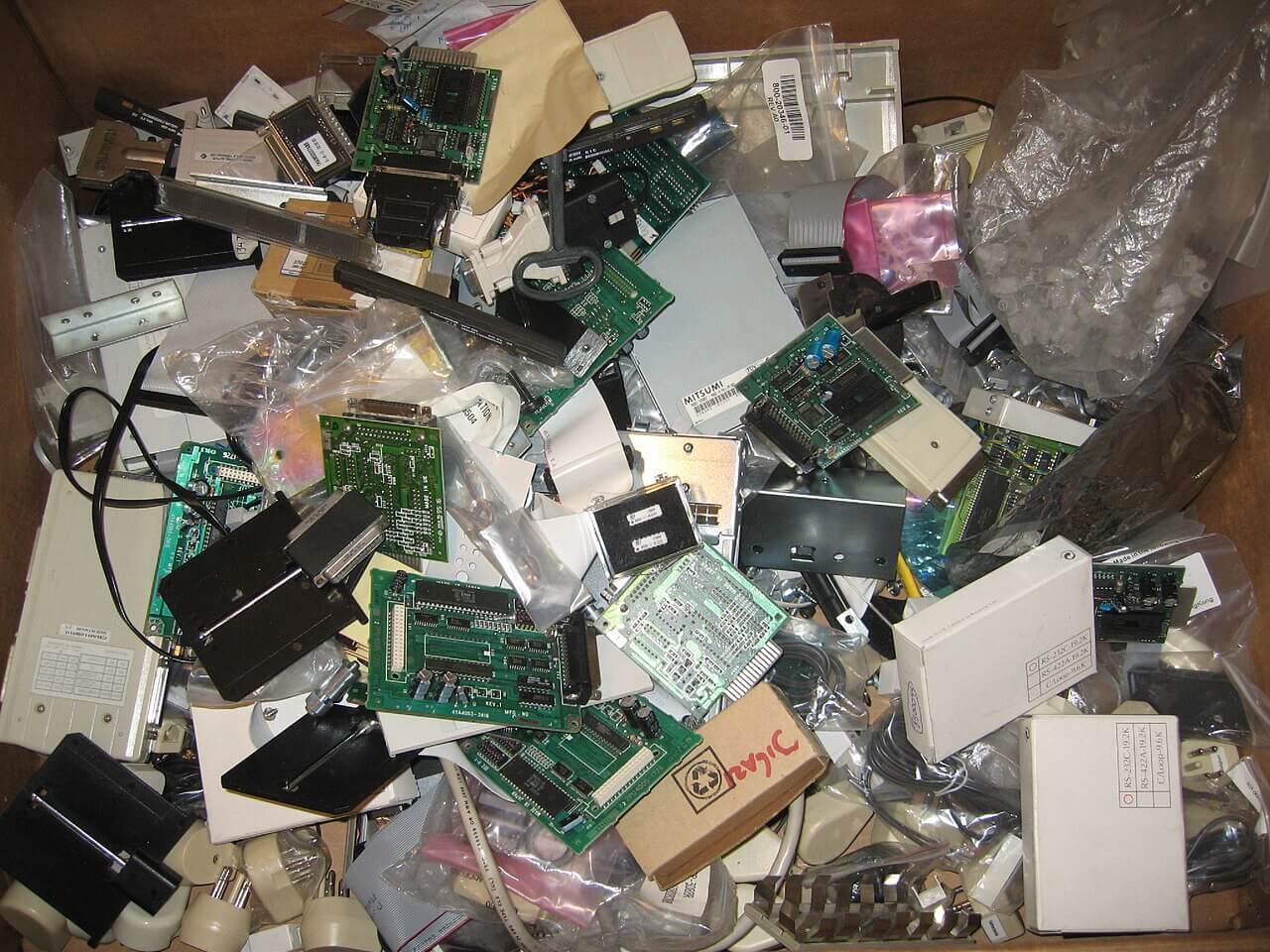
The United States is sitting on a growing mineral supply hidden in plain sight: discarded electronics. Recovering lithium, cobalt, and rare earths from this waste, known as urban mining, could help strengthen the country’s domestic mineral supply, even though recycling these materials is not always as profitable as traditional mining under current market conditions.
Electronic waste contains extremely high concentrations of valuable metals. Studies show that one metric ton of e-waste can hold up to seventy times more gold than typical mined ore, while printed circuit boards and other components contain much higher concentrations of metals like copper and gold than natural ores. This is why e-waste is often called “urban ore.” Advances in recycling technology now make it increasingly possible to recover these materials efficiently. Modern lithium-ion battery recycling processes can recover most cobalt and nickel, along with large shares of other metals, using hydrometallurgical methods.
>>>READ: Harvest Deep-Sea Minerals to Combat China
The economic advantage of recycling is becoming clearer each year. Traditional mining requires enormous upfront costs for exploration, permitting, land use, water, and long operational timelines. Urban mining avoids nearly all of these challenges because the “ore” has already been collected and refined once, existing in phones, laptops, hard drives, and batteries. Recycling lithium‑ion batteries and other electronic waste currently costs roughly $600 to $1,200 per ton, depending on the technology used. These processes achieve high recovery rates for critical minerals and generally use less energy than extracting new materials from the ground. Compared with the costs, permitting, and environmental impacts of opening new U.S. mines, recycling is increasingly an attractive option for supplementing the domestic mineral supply.
Urban mining can help reduce U.S. exposure to geopolitically sensitive supply chains. China dominates the processing of rare earths and other critical minerals and has repeatedly used export controls in strategic disputes, leaving the U.S. vulnerable to supply disruptions. Why America should mine its e-waste. At the same time, Americans hold valuable devices in drawers and closets, representing a “lost resource” of critical minerals, according to the University of Houston. Recovering these materials through e‑waste recycling could strengthen domestic supply, reduce reliance on foreign sources, and mitigate environmental risks from landfilling.
For years, the main obstacle to large-scale recycling has been economics rather than technology. The process involves many disconnected actors, manufacturers, collectors, processors, and recovery firms, each with different incentives, which has historically limited the coordination and profitability of urban mining. Researchers at the University of Houston have developed a theoretical collaborative cost-sharing model that could better align stakeholders, spreading costs and profits more evenly and making recycling financially more viable.
>>>READ: A Major Mining Milestone
Urban mining will not eliminate the need for traditional mining, but its economic case is strong. It bypasses exploration, shortens supply chains, reduces geopolitical exposure, and converts waste already inside U.S. borders into a strategic resource. Instead of waiting a decade or more for new mines to come online, the U.S. can recover the minerals it has already imported, purchased, used, and thrown away. The result is a cheaper, faster, and more secure path toward mineral independence, one built not on digging deeper, but on recovering what we have already buried.
The views and opinions expressed are those of the author’s and do not necessarily reflect the official policy or position of C3.