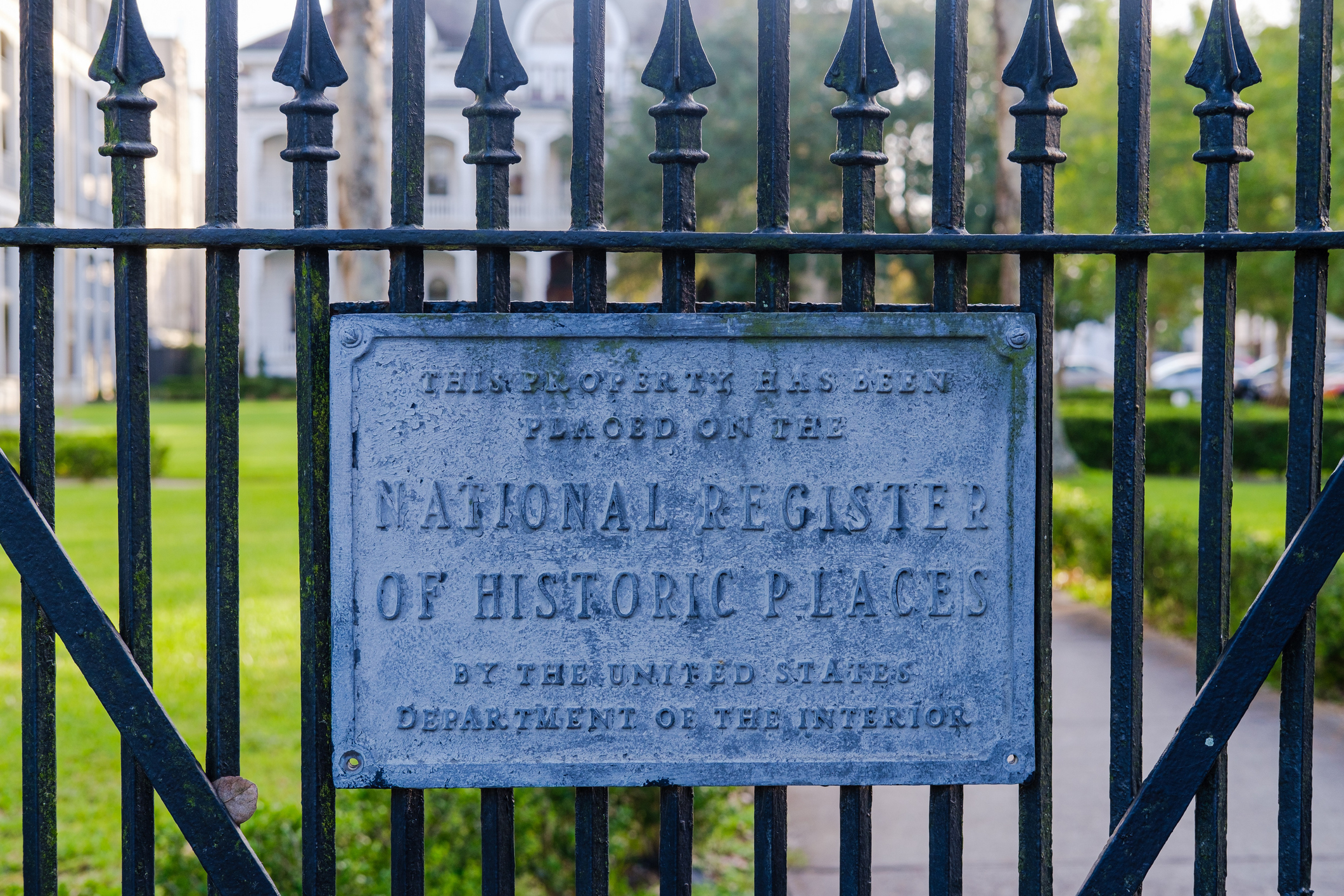
Heading into the August recess, policymakers continue to hash out the details of a comprehensive permitting bill in hopes of sending it to President Trump’s desk this Congress. There is bipartisan recognition that permitting reform is essential to improving energy affordability and reliability, and to meeting our environmental ambitions. As the discussions on Capitol Hill evolve, one law starting to receive more attention for reform is the National Historic Preservation Act (NHPA).
History and the Open-Ended Processes of NHPA
The NHPA was enacted for good reason. Rapid post-World War II development destroyed cultural and historic sites at a staggering pace. By the time Congress acted in 1966, half of the National Park Service’s Historic American Building Survey sites had already been destroyed or irreparably damaged.
Section 106 of the Act is the core compliance process that requires federal agencies to consider how projects they fund, permit, or carry out affect historic and cultural resources. The Act also established the institutions that carry out Section 106. It created the Advisory Council on Historic Preservation (ACHP), an independent agency that advises Congress and the President and writes the rules governing Section 106 review. It also established State Historic Preservation Offices (SHPOs) and was later amended to create Tribal Historic Preservation Offices (THPOs), creating a federalist system in which states and tribes, not Washington, lead most of the actual preservation work.
The compliance process is as follows. Agencies must determine whether the federal action constitutes an undertaking with potential effects. If so and the action does not fall under one of the defined program alternatives, agencies must identify historic properties within the Area of Potential Effects (APE). In this process, agencies involve SHPOs, THPOs, and other consulting parties, such as local governments, archaeologists, landowners, and the public, as necessary.
The APE can include direct or indirect impacts the undertaking may cause, such as physical, audible, and visual effects. Consequently, the APE for large infrastructure projects, such as pipelines or transmission lines, can span thousands of square miles and take years to survey.
If an agency finds nothing historic in the APE, it must document the finding and give the SHPO/THPOs 30 days to object. If no objection is raised, the consultation process ends. If an objection is raised, the agencies and SHPOs engage in additional consultation or refer it to the ACHP, which has 30 days to weigh in. The agency must then respond and explain why it reached their conclusion.
If a historic property lies within the APE, the agency must assess whether the action it’s considering will affect the property. If the project has adverse effects, the parties negotiate a Memorandum of Agreement. This legally binding document outlines how the agency will mitigate harm to the historic property. There is no deadline for the negotiation to conclude, so it can drag on for months or years. Additionally, mitigation requirements may have little, if any, relevance to the preservation of the cultural site. For instance, mitigation agreements have included funding podcasts, roadside attractions, and fitness lanes.
What’s Considered a Historic Property, Landmark or Artifact?
The National Register covers a wide range of structures, buildings, and objects, including state capitols, courthouses, and neighborhood historic districts, as well as bridges, battlefields, cemeteries, monuments, and even amusement park rides. The former home of the New Orleans Saints, the Louisiana Superdome, is on the National Register of Historic Places. A property generally must be at least 50 years old and retain its historic integrity. Properties younger than 50 years can still qualify, but only in rare cases of “exceptional importance,” or if they’re part of a larger historic district that already qualifies.
Nominations typically start with a property owner, historical society, local government, or tribe, and go through the State Historic Preservation Office (or the Tribal or Federal Preservation Officer for tribal or federal land). The property must meet at least one of four significance criteria: association with historic events, connection to important people, distinctive architecture or engineering, or archaeological potential. The SHPO then notifies affected owners and solicits public comment before a state review board makes a recommendation. From there, the National Park Service’s Keeper of the Register makes the final call, typically within about 45 days of a complete nomination reaching Washington. Owner objection can block a listing outright. Start to finish, the process commonly takes one to two years.
>>>READ: Restoring Predictability to Historic Preservation Review
A National Historic Landmark (NHL) asks whether it’s of national significance, and the bar for proving that is considerably higher. Candidates go through a National Park Service survey, review by the National Park System Advisory Board, and a personal designation from the Secretary of the Interior, rather than a state-level sign-off. NHLs are subject to a tougher standard than ordinary Register-eligible sites, requiring agencies to loop in the ACHP and take concrete steps to minimize harm. Roughly 90,000 to 100,000 properties sit on the Register, and just over 2,600 have NHL status.
It’s worth noting that even historic projects not listed on the Historic Register may still be included as an affected site, as long as it meets one one the four eligibility criteria. This requires federal agencies to evaluate both listed and unlisted structures.
Effects on Energy, Infrastructure and Conservation Projects
For large energy, forestry, and transmission projects, outdated tools, inconsistent implementation, open-ended timelines, undefined requirements, and opportunities for litigation have made Section 106 a serious bottleneck. For instance, defining the area of potential effects, identifying and evaluating historic properties, and conducting surveys have no fixed timeline.
Lawsuits are also a problem, and there are many opportunities to bring a claim. When a federal agency’s Section 106 compliance is challenged in court, the lawsuit is typically brought under the Administrative Procedure Act, which means the court can only review the agency’s final decision and must defer to the agency’s judgment unless it was arbitrary or unreasonable. A recent Institute for Progress report notes that:
APA standard applies to procedural questions such as whether the agency appropriately defined and documented the area of potential effects; made a reasonable and good-faith effort to identify historic properties; consulted adequately with SHPOs, THPOs, Tribes, NHOs, applicants, local governments, and other consulting parties; evaluated National Register eligibility; assessed adverse effects; addressed objections or contrary evidence raised during consultation; and adequately documented its no-effect, no-adverse-effect, or adverse-effect findings and any avoidance, minimization, or mitigation measures the agency chose to adopt in an MOA, PA, or other resolution document. While mitigation measures are not legally required, an agency could still be found arbitrary and capricious in deciding not to adopt a mitigation measure that was proposed but that the agency declined to adopt without a reasonable explanation.
Lawsuits can result in injunctions, vacatur, or remand without vacatur, depending on the circuit’s precedent.
Idaho Power’s proposed 300-mile transmission line, the Boardman to Hemingway project, spent 18 years in permitting before construction began in 2025. BLM initiated the Section 106 process in 2011, and that consultation was still ongoing as of 2025.
>>>READ: Permitting Reform – The Commonsense Fix for America’s Cost of Living Crisis
The SunZia Southwest Transmission Project illustrates the same challenge on a larger scale. The $10 billion, 520-mile line is one of the largest transmission projects ever built, and its Area of Potential Effects grew accordingly: an estimated 40,000 to 80,000 acres for direct effects, roughly the size of Washington, D.C., plus a five-mile buffer on either side for visual effects covering an estimated 5,200 square miles. Historic property determinations also came late in the process, contributing to litigation that continued even after construction was underway. With clearer APE standards and earlier, better-resourced consultation, developers would have more certainty, and tribes and historic preservation offices would have a more meaningful role earlier in the process, rather than a legal fight after the fact.
C3 Solutions has proposed reforms to Section 106 that would provide more certainty for developers, speed up critical energy and conservation projects, and maintain historic preservation.
- Clarifying the Area of Potential Effects (APE) and impact scope
At a Senate hearing last fall on NHPA, Montana Dakota Utilities’ Andy McDonald described how one of their projects was delayed at the APE stage. Rebuilding a three-mile distribution line, including upgrading it for wildfire safety, was delayed when agencies couldn’t agree on what counted within the Area of Potential Effects. One agency said the entire project, including private land, must undergo Section 106. The other limited review to the area within its own jurisdiction. In cases like these, having a lead agency driving the process would help ensure projects don’t get held up unnecessarily.
Clarifying what counts as an effect would also help. Speculative effects should not drive consultation; only direct, proximate, and causal impacts should count. SunZia’s five-mile, 5,200-square-mile visual effects buffer shows how much room the APE currently has to expand well beyond a project’s footprint.
- Narrowing Judicial Review
Because Section 106 is far less litigated than NEPA, its limited case law can create uncertainty for developers and agencies alike. As Stacey Bosshardt noted in a 2026 analysis for the American Bar Association’s Natural Resources & Environment journal, courts have at times treated Section 106 as requiring mitigation measures that are not found in the law itself.
The Supreme Court has already pushed back on similar NEPA interpretations in the Seventh County case, making clear that procedural statutes enforced through the APA do not require fully developed mitigation plans. Congress should bring the same clarity to NHPA. Alongside reforms such as limiting review timelines, narrowing review to the project at hand, and allowing remand without vacatur, these changes would make permitting more predictable without weakening historic protections or public participation.
- Prioritize Nationwide Digitization, Modeled After Utah and Washington
One of the biggest barriers to an efficient Section 106 process is that many cultural and historic records remain in paper files or fragmented databases. States such as Utah and Washington have shown that digitizing systems drastically reduces review times.
Utah’s State Historic Preservation Office fully digitized its records in a GIS-based system in 2017 and has since completed 98 percent of reviews within seven days, saving roughly $350,000 annually in printing and mailing costs. Washington State’s WISAARD platform has been similarly successful. It combines GIS mapping with electronic Section 106 submissions and allows reviews to be completed in just 3 to 4 days. To achieve this on a large scale, Congress should allocate funding and technical support to enable State and Tribal Historic Preservation Offices to build modern, centralized databases.
- Expand the Use of Programmatic Agreements
Some tools already exist to help agencies streamline the Section 106 process. Programmatic agreements allow federal agencies, the Advisory Council on Historic Preservation, and State or Tribal Historic Preservation Offices to agree in advance on how routine categories of projects will be reviewed. They are among the most effective tools available and can save significant time and money.
By creating a more predictable process for routine, low-impact work, or work done on a large scale, these agreements help agencies move projects forward more efficiently. For large-scale forest management projects, these agreements even allow consultation to proceed in phases while work begins in other areas, so critical management needed to ensure the safety of our forests and communities does not stall while every detail is finalized. Agencies should proactively incorporate more programmatic agreements into their historic preservation work.
- Explore Ways for Voluntary, Incentive-Based Mitigation
While Section 106 does not require mitigation outcomes under the law, preserving cultural and historic resources is an important goal. Congress and the Advisory Council on Historic Preservation should explore voluntary frameworks that reward developers who engage tribes and stakeholders early and reach agreements before the formal review process begins.
Certain environmental laws already use similar incentive-based approaches successfully, including wetland mitigation banking under the Clean Water Act and safe harbor agreements under the Endangered Species Act. Creating expedited review pathways and legal certainty for early agreements could encourage more of the kind of early, collaborative engagement that projects like SunZia would have benefited from.
As Congress pushes forward with permitting reform, the National Historic Preservation Act should remain a priority. Reform would continue to protect cultural and historic resources while giving agencies and developers the clarity and predictability needed to build the energy, transmission, and conservation projects the 21st century requires.
The views and opinions expressed are those of the author’s and do not necessarily reflect the official policy or position of C3.