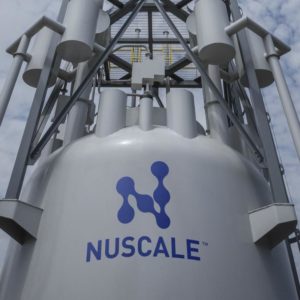
"With respect to safety, forty years ago we were very focused on the potential for low-probability, high-consequence accidents in which the fuel in a nuclear power plant could melt and release radiation to the environment. In response to this risk, nuclear energy technologies in the United States are carefully designed and operated to avoid accidents and minimize their consequences. Here again, several decades of experience of nuclear industry operations, overseen by the NRC, have demonstrated that accidents are very rare, and when they do occur, the radiation exposure is minimal."
Articles from Around the Web
Altman-Backed Startup Bets on Heat and the Sun to Tackle AI’s Massive Carbon Footprint
"Exowatt’s system stores that solar energy in a heat battery made of a clay and ceramic composite, a cheap medium that’s readily available in US supply chains, Parvizian said. That heat can be stored for months, but most of Exowatt’s customers are looking for eight to 24 hours of energy to dispatch, allowing them to use it as electricity when other sources are more expensive."
Florida looks at the possibility of adding nuclear power
"Jacob Williams, general manager and CEO of the Florida Municipal Power Agency and chairman of the Florida Electric Power Coordinating Group, said the state needs to diversify its energy sources, as about 75 percent of electricity is generated with natural gas. While utilities continue to build solar facilities, Williams said nuclear power could be important in meeting future needs."
Fossil Fuel Lawsuits Are A Tax On Consumers
"Suing fossil fuel producers for the costs of climate change is economically damaging, environmentally suspect, and based on dubious claims. It will also harm families, particularly working families, at a time when they are already struggling with the high cost of living. Ultimately, there are many serious adverse consequences from state and local litigation against traditional energy companies, but no economic upsides should the plaintiffs prevail."
New tech can make air conditioning less harmful to the planet
"Blue Frontier, a company based in Florida, is attempting to harness the cooling effects of evaporating water. Its approach makes use of a liquid desiccant, similar to ultra-salty brine, to remove moisture. The dried air is then split into two streams, one of which is passed over a thin layer of water to induce evaporation. This lowers the temperature of the surrounding metal, which in turn cools the other airstream before it is directed back into the room."
The Government’s Permitting Regime Is Choking the Economy
"This isn't just good policy; it's a moral imperative. Permitting reform is about restoring a healthy power balance between government and individual and ensuring that America remains a place where innovation thrives, entrepreneurs succeed, and opportunity is universal. It's about reclaiming the principles that made this country great."
Google unveils new heat resilience tool for cities
"While heat officers can advocate for policies, they often lack decision-making power within a city or regional government."
Netflix Wants to Shrink Your Favorite TV Show’s Carbon Footprint
"If Netflix persuaded its suppliers to buy low-emissions equipment, it could prompt an industry-wide change. Netflix’s emissions are broadly in line with its industry peers, and its challenges are the same. The same shops that rent lights, portable power sources and vehicles tend to service productions across the various studios, and so more green tech for Netflix means more all around. And if the company succeeds in communicating to the makers of this equipment that a buyer exists, that would help de-risk the investment and encourage more adoption industry-wide."
More cleantech companies fail as fundraising challenges emerge
"Part of the challenge for cleantech companies is the number of rising sectors that are now competing for funding. '[Cleantech] companies have struggled to grow revenues at margins that would chart a path to profitability,' said Bilal Zuberi, a general partner at Lux Capital. 'Venture capitalists have seen a larger-than-expected portion of their [cash] reserves called into other sectors like AI, life sciences and defence tech.'"
Do Green Energy Subsidies Work?
"The overwhelming majority of green energy subsidies reward politically powerful constituencies and businesses whose primary purpose is not to build better energy mousetraps but to build only ones that qualify for the largest subsidies."