Across the country, runners are gathering to race up and down local mountains as many times as they can. What began in Utah’s Wasatch Mountains has spread to cities all over the West. Why? To raise awareness about Salt Lake City’s worsening air quality, driven in part by the shrinking of the Great Salt Lake.
There’s a reason the Great Salt Lake earned its name. It is the largest salt lake in the western hemisphere and the 8th largest in the world. The lake and surrounding wetlands provide habitat to incredible diversity– brine shrimp, migrating birds, waterfowl, and native plant life. But its significance extends beyond biodiversity. From brine shrimp harvesting to recreational tourism to mineral mining to agriculture, the lake is foundational to Utah’s economy.
But the Great Salt Lake is drying up. Since the mid-1980s, the lake has dropped 22 feet, and its surface area is 60 percent smaller than it once was. If that doesn’t sound like a lot, consider this: it takes 12 minutes and 13 seconds to walk from where the lake’s shoreline once was to where it is today. The primary drivers are agricultural water diversion and a population that has nearly doubled in the Salt Lake metropolitan area since the 1980s, with climate change and snow droughts adding additional pressure, according to NASA.
The state’s environment, economy, and public health have all been hit by the declining lake.
In 2022, the lake’s salinity reached a record high, a level known to harm the survival of brine shrimp, which anchor the lake’s food web. Without brine shrimp, hundreds of thousands of migrating birds could lose an important food source needed for their migration.
As more of the lake dries, dust is left exposed to the wind. When those particles settle onto nearby mountain snowpack, they darken its surface and accelerate melting, leaving less water available during the hot, dry months when communities and farms depend on it most.
A recent analysis found that dust from exposed lakebed contains heavy metals and neurotoxins. As the shoreline recedes, wind can lift dust containing these harmful chemicals into surrounding communities, degrading air quality and increasing exposure to pollutants. Research on shrinking saline lakes shows that this kind of dust can pose health risks, especially to the respiratory system, though researchers are still working to refine whether fine particulate matter, specific contaminants, or both are driving those conditions. For vulnerable populations, especially children, the elderly, and those with health conditions, the risks warrant serious attention.
Although it may seem extremely difficult, if not impossible, there should be optimism that the Great Salt Lake can be refilled. But we need to give it the best tools we can. Thankfully, the State of Utah, conservationists, and human ingenuity are already at work.

Recognizing the severity of the problem and the importance of voluntary conservation, the state of Utah has made reforms to its water rights laws. Three main rivers flow into the Great Salt Lake, and the water rights system that has guided the use of those rivers has previously hindered conservation by operating under a “use it or lose it” mentality, in which water rights holders who don’t use allocated water risk forfeiting their future rights. Recent legislative changes have modernized this system, making it more flexible by allowing environmental flows to count as a valid use of water rights.
The water rights holders are incentivized to conserve their water through monetary compensation from conservation groups or the state.
>>>READ: Policy Inaction Threatens the West’s Energy and Water Supplies
A PERC report released last year highlighted the challenges water markets still face in Utah, despite new legislation that allows for their adoption. One of the most pressing challenges is the difficulty of measuring and monitoring used and unused water. Quantifying how much water is available from the amount allocated in their water rights is crucial for a farmer to participate in water leasing. Concerns about whether leased water actually reaches the lake and legal obstacles embedded in traditional water laws also cast doubt on the efficacy of water leasing. Farmers, who hold most of the basin’s water rights, have also been wary of transferring water out of communities.
While more needs to be done to address those challenges and encourage broader adoption, water leasing is a promising way to conserve water needed to refill the Great Salt Lake while opening additional revenue streams for farmers in the area.
Another solution, piloted by Utah and the private sector, is the strategic use of cloud seeding to increase precipitation. Cloud seeding is an American-made technology that has been in use for nearly 80 years. The process involves dispersing fine particles, typically silver iodide, into clouds to encourage ice crystal formation and increase the likelihood of snow and rain. Utah has been piloting cloud seeding programs since the mid-20th century. In 2023, Utah boosted its efforts with a $12 million one-time allocation and subsequent annual payments of $5 million.
Leading the charge is Rainmaker, an El Segundo-based startup founded by Thiel Fellow Augustus Doricko in 2023. Though cloud seeding has been around for nearly 80 years, it has long operated under widespread skepticism. Not because the science was unsound, but because it was difficult to measure and verify success. For instance, if you seed a cloud and it rains, you can’t easily prove that your efforts caused it without robust real-time monitoring, and that attribution gap has kept the industry underfunded for decades.
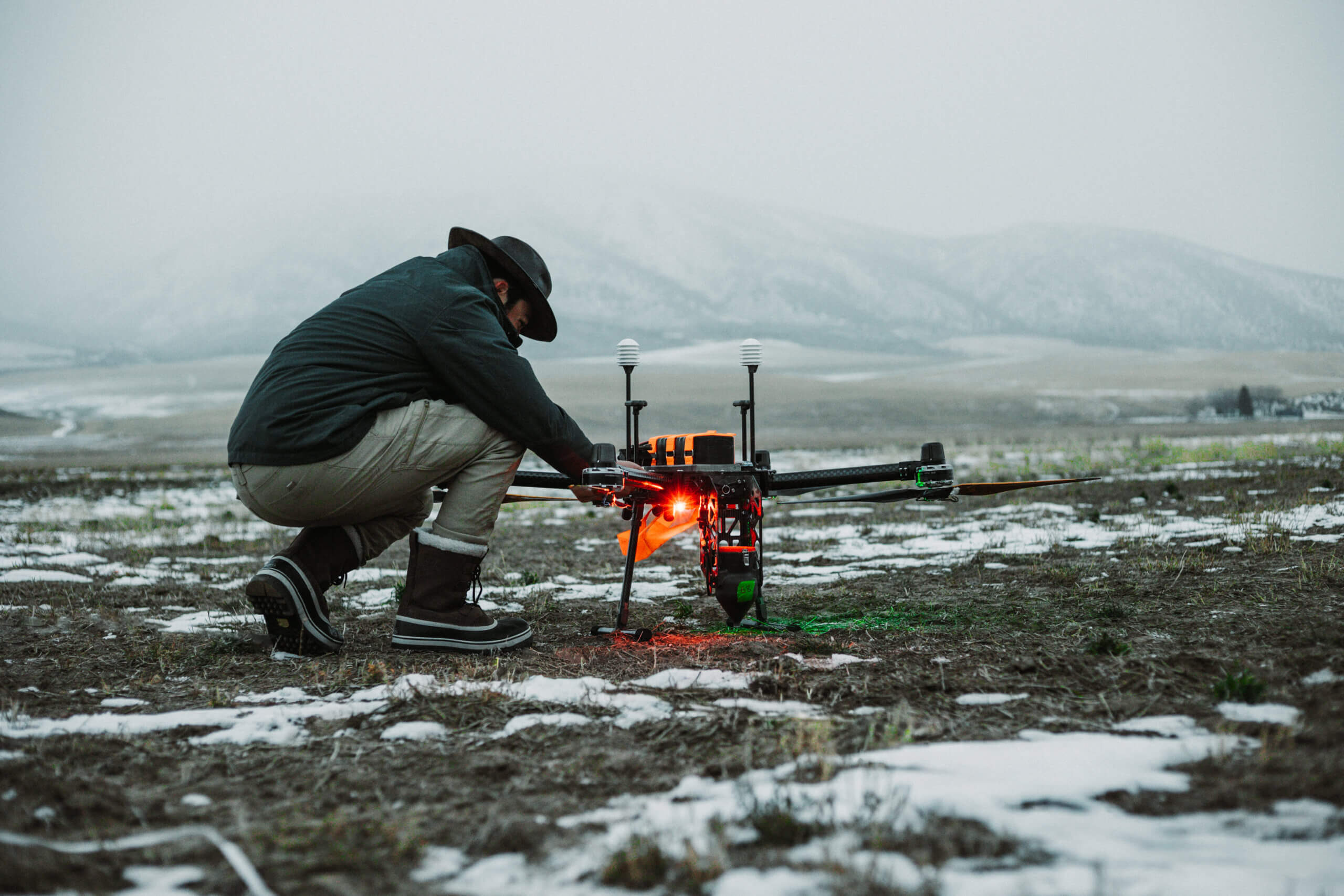
Rainmaker has solved that problem by modernizing the technology. Traditional cloud seeding efforts have operated from ground-mounted systems or aircraft dispersal. Rainmaker instead deploys weather-resistant drones that fly directly into clouds and release precise amounts of silver iodide. A paired radar system tracks changes in clouds in real time, allowing the company to quantify additional snowpack or rainfall in acre-feet. And, all of their technology is designed and built in America.

The company has contracts with water agencies and states across the Western U.S., according to E&E News, and has raised more than $50 million since its founding. In Utah, Rainmaker operates under contract to the state’s cloud seeding program, a public-private partnership where state funding provides the foundation and Rainmaker supplies the technology.
After completing their inaugural season in Cache Valley between January and April 2025, they are now leading the Bear River Basin Cloud Seeding Program into its second season, with an additional $3 million in state funding. The Bear River drains a 7,600-square-mile watershed spanning Utah, Idaho, and Wyoming before emptying into the Great Salt Lake, and is one of three main rivers that feed the lake.
Rainmaker’s goal is to generate over 10 billion gallons of precipitation in the basin this season. The state of Utah claims it can boost annual snowfall by 6 to 12 percent annually. Enough to make a difference, but not enough to negatively impact ecosystems. Over time, that could mean the difference between farmers yielding crops, forests burning less, and ecosystems beginning to recover.
While saving the Great Salt Lake has largely been a state responsibility, it has recently garnered federal attention. Just this weekend, the President posted on Truth Social that he’s working with Governor Cox to save the Great Salt Lake. It’s unclear what federal involvement would look like. But the fact that the lake is now part of the national conversation highlights just how important this issue is.
Saving the Great Salt Lake will be no simple task. But with smarter water policy, voluntary conservation, and the force of human ingenuity, it’s a challenge within reach.
The views and opinions expressed are those of the author’s and do not necessarily reflect the official policy or position of C3.