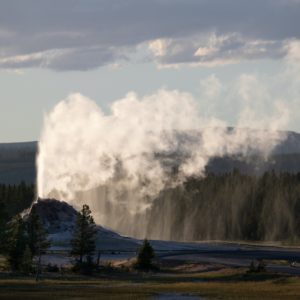
"Geothermal energy from coal mines can be used not only to heat homes and buildings, but also to cool them. That opens up many more opportunities, especially for data centers. They are some of the worst carbon offenders, using vast amounts of energy and requiring thousands of gallons of water to cool themselves. Now, researchers in Scotland are studying how hot air from data centers can be pumped into coal mines and then recovered from the water to heat other buildings."
Westinghouse Launches New Small Modular Nuclear Reactor
The AP300 is Westinghouse’s latest addition to its vast portfolio of reactor technology
Solving The Biggest Problem With Wind Energy
"After six days of catalysis in the laboratory, a piece of a wind turbine blade was dissolved into intact glass fibers and bisphenol A, which can be used in the production of new blades – in addition to a fraction of various oligomers, which cannot be recycled. The metal piece was cast into the wing as part of the wind turbine’s lightning protection."
Where to Find the Energy to Save the World
"For a long time, people have been gathering that heat and using it to warm nearby buildings or turn turbines that generate electricity. Iceland gets about two-thirds of its energy—and nearly 100 percent of its heat—from geothermal sources. The city of Boise, Idaho, uses geothermal to warm some downtown buildings, and it has for more than a century."
Three Midwestern States Partner For Clean Hydrogen Hub
With two hydrogen coalitions in place, the Midwest is in a great position to lead the nation and potentially the world in developing this clean energy source.
This startup uses volcanic rock dust to suck carbon dioxide out of the air
"Startup Lithos Carbon, however, is focusing on the land, and a natural tool: basalt, a black igneous rock that’s common on volcanically active islands like Hawaii and Iceland. Lithos recycles existing basalt dust—a quarrying by-product—and spreads it over crop land. When rainwater mixes with the basalt dust, it triggers a chemical reaction that captures and locks up CO2 as bicarbonate."
Can this Plastic-Eating Mold Help Solve the Plastic Pollution Challenge?
The backyard fungi can break down plastic in just 140 days.
A New Report Highlights the Path Toward Widespread Advanced Nuclear
Innovative companies are driving nuclear power to new heights. Advancements in design and technology mean that future nuclear will be even safer, simpler to deploy, and more widespread than it is today, which is already one of the safest forms of energy on the planet. A new report from the U.S. Department of Energy (DOE)...
FuelCell Energy Takes Step Toward Commercializing Carbon Capture Technology with ExxonMobil
"The modules will use carbonate fuel cells to efficiently capture and concentrate carbon dioxide streams. Combustion exhaust from an external source, like a flue stream, will be directed to the fuel cell, which electrochemically reacts fuel and air to produce power, while capturing and concentrating carbon dioxide for utilization or permanent storage. The modular design enables the technology to be deployed at a wide range of locations, operate at high efficiency, and advance business goals at hard-to-decarbonize industrial and commercial applications."
Searching for Advanced Nuclear Power Technology? Look to Idaho
"The MARVEL reactor will be constructed at INL’s Transient Reactor Test Facility. Yasir Arafat, project lead for MARVEL, showed me the site and provided an overview of the project. Arafat explained that microreactors are 'very tiny reactors' compared to today’s more standard gigawatt-scale commercial units. He said they typically produce single-digit megawatt output, although some can run up to 20 MW or more. Arafat noted that microreactors have three key features: they can be built in factories, transported over standard roads, and are self-regulating, that is, they’re automated to operate safely without human interaction."