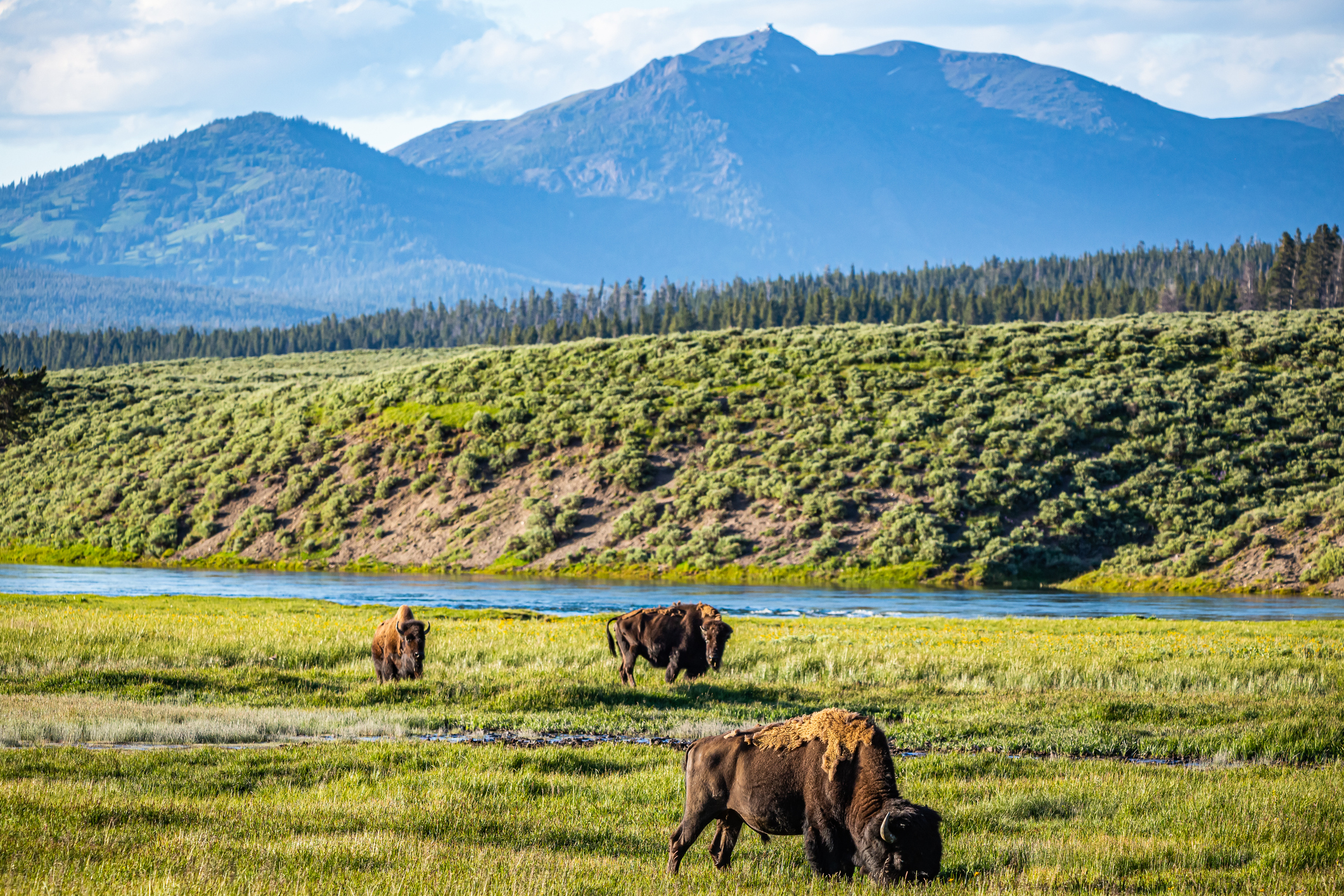
Earlier this month, a federal judge temporarily blocked the Bureau of Land Management (BLM) from forcing hundreds of bison from BLM grazing allotments in Montana. The ruling came months after BLM finalized the decision to revoke the conservation group American Prairie’s grazing permits and clear its bison off federal land by the end of September.
BLM’s finalized decision in May centered on a new reading of “livestock” under the Taylor Grazing Act (TGA), stating they can only authorize grazing for “production-oriented” livestock– animals raised for purposes like food or fiber. Because American Prairie grazes bison for conservation, BLM concluded they no longer qualify for federal permits, despite holding permits dating back 20 years.
American Prairie is a conservation nonprofit intending to build one of the largest nature reserves in the United States. Prairies are among the world’s most endangered ecosystems. Less than 200 years ago, more than one-third of North America was covered by prairie; today, just 4 percent of that original area remains. According to American Prairie, biologists estimate that a fully functioning prairie, with its native wildlife and migration corridors, would need to be roughly 3.2 million acres, which is the size the group intends for its reserve.
Prairies support plant and animal biodiversity, but they also support ecosystem services that benefit people. They provide habitat for pollinators that are essential to our food chain and are vital to the watersheds we rely on.
Since 2004, the group has been purchasing private land and obtaining grazing permits to weave together private and public land. It’s a model with longstanding bipartisan appeal: privately funded, voluntary conservation at no cost to taxpayers. The group has been doing it successfully for two decades.
So why would the BLM revoke their permits, and does the agency’s rationale hold up? The law itself and a past Supreme Court case say otherwise. Grazing permit eligibility under the TGA is based on the requirements that a landowner owns stock as well as private property that serves as a working base to support that stock. A public comment from the Property and Environment Research Center references the court case Public Lands Council v. Babbitt, where the Supreme Court found no evidence that Congress intended permit holders to be in the commercial livestock business.
>>>READ: How Satellite Technology Is Unlocking Virtual Fencing for Ranchers
The Court held that owning stock was enough to qualify for federal grazing permits, whether or not the permittee ran a commercial operation. BLM acknowledged the production requirement isn’t stated in the law, only that it’s “heavily implied.” The agency is bound by the statute, not its preferences or interpretations.
Importantly, even if production were required, American Prairie would qualify. It runs an annual harvest to manage its herd and has yielded 75,000 pounds of meat over the past decade.
The federal government should not pick winners and losers. In the American Prairie case, it should not side with ranchers who opposed the group over legitimate permits obtained in land sales. Ranchers’ concerns are understandable and deserve attention. When a conservation group buys land and obtains permits across a traditional agricultural region, the ranching economy shrinks. But that’s an argument about land use, and it doesn’t give the federal government authority to rewrite the law. Instead, it should respect property rights and permits that people and businesses make investments in and build their operations on, and it should allocate those rights based on willingness to pay and according to the law.
With the recent injunction, American Prairie can continue grazing their bison on three allotments for now. However, the injunction is only temporary, and the case has yet to be decided. The Bureau of Land Management should rescind its decision and restore certainty to the group and federal permit holders alike.
The views and opinions expressed are those of the author’s and do not necessarily reflect the official policy or position of C3.